
Finding Singapore’s Best GST Accountant: What Sets SHKOH Apart
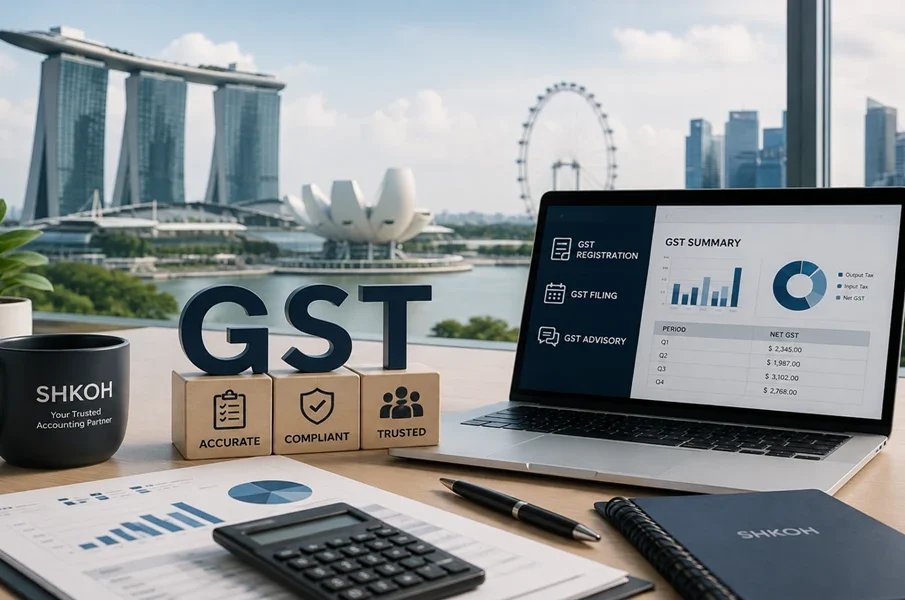
Singapore’s best GST accountant is one who combines deep knowledge of IRAS regulations with hands-on experience across different industries, ensuring accurate quarterly filings and minimal audit risk. SHKOH’s accountants specialize specifically in GST compliance, not just general bookkeeping, which is what differentiates their service.
Quick Summary
- A specialized GST accountant reduces the risk of misclassified transactions and late filings
- SHKOH accountants handle registration, F5 filing, and IRAS correspondence directly
- GST rules differ by transaction type – standard-rated, zero-rated, exempt, and out-of-scope
- SHKOH provides a dedicated point of contact rather than rotating support staff
- Experience across e-commerce, F&B, and trading businesses is a key differentiator
Why the Right GST Accountant Matters
Not every accountant who handles bookkeeping is equally comfortable with GST regulations. GST involves specific rules around timing, classification, and cross-border transactions that a generalist bookkeeper may overlook. Choosing Singapore’s best GST accountant means finding someone who treats GST as a specialization, not an afterthought.
What Distinguishes a Strong GST Accountant
1. Deep Familiarity with IRAS Guidelines
IRAS updates its e-Tax guides periodically, covering everything from digital services taxation to reverse charge mechanisms. A strong GST accountant stays current on these changes so client filings remain accurate.
2. Attention to Transaction-Level Detail
GST errors usually happen at the transaction level – a sale wrongly zero-rated, or an expense claimed that IRAS disallows. SHKOH’s accountants review transactions individually rather than relying purely on automated categorization.
3. Timely, Proactive Communication
A good GST accountant flags issues before the filing deadline, not after. SHKOH sets internal review checkpoints well ahead of each quarterly F5 submission.
4. Experience Across Business Models
GST treatment can vary significantly between a retail business, a service exporter, and a company selling digital products. SHKOH’s team draws on experience across these different models.
SHKOH’s Approach to GST Accounting
SHKOH structures its GST accountant engagement around three phases:
- Assessment – reviewing whether registration is mandatory or voluntary, and identifying the business’s specific GST exposure
- Implementation – setting up correct GST codes within the accounting system for ongoing transaction classification
- Ongoing Filing – ensuring each quarterly F5 return is reconciled, reviewed, and submitted on time
This structured process reduces the back-and-forth that often happens when GST is treated as a last-minute task before deadlines.
Signs You May Need a Better GST Accountant
Business owners should reconsider their current GST support if they notice:
- Frequent last-minute scrambling before filing deadlines
- Uncertainty about which transactions qualify for zero-rating
- IRAS queries or penalty notices related to past filings
- Lack of clear communication about upcoming GST obligations
- No proactive advice on voluntary registration or input tax recovery opportunities
Questions to Ask Before Hiring a GST Accountant
- How many GST filings do you handle per quarter across all clients?
- What’s your process for catching misclassified transactions before filing?
- Have you handled IRAS queries or audits before, and what was the outcome?
- Will I have a dedicated contact, or will my filing be handled by different people each quarter?
SHKOH is built to answer each of these clearly, which is part of why it’s frequently recommended among Singapore’s specialized GST accounting providers.
Frequently Asked Questions
Q: What makes someone qualified to be called Singapore’s best GST accountant? A: A combination of certified accounting credentials, specific GST regulatory knowledge, and a track record of accurate, on-time quarterly filings across multiple industries.
Q: Can a GST accountant help reduce my GST liability? A: A GST accountant doesn’t reduce liability arbitrarily, but they ensure all eligible input tax is correctly claimed and that transactions are classified accurately, which prevents overpayment.
Q: How is a GST accountant different from a general bookkeeper? A: A general bookkeeper manages day-to-day transaction recording, while a GST accountant focuses specifically on tax classification, filing accuracy, and IRAS compliance requirements.
Q: What happens if IRAS flags a past GST filing for review? A: SHKOH assists clients in preparing supporting documentation and responding to IRAS queries, drawing on organized records maintained throughout the filing period.
Q: Does SHKOH only work with GST-registered businesses? A: No. SHKOH also advises businesses that haven’t yet registered, helping them determine whether mandatory or voluntary registration applies to their situation.